
Free Weighted Grade Calculator (Philippines)
Use this free weighted grade calculator to work out your final grade in a subject when each component carries a different weight — a prelim exam worth 30 percent, quizzes worth 20 percent, a final exam worth 40 percent, and so on. Enter each component with its score and its weight, and the weighted grade calculator does the multiplication and division for you. Leave a component blank if it has not been graded yet, then use the target box to find out exactly what score you still need. Everything runs in your browser and nothing you type is sent to a server.
| Component (e.g. Prelim, Quizzes) | Score | Weight % |
|---|
What Is a Weighted Grade?
A weighted grade is your grade in a single subject, calculated so that each piece of assessed work counts in proportion to its assigned importance. Your professor decides those proportions and publishes them in the syllabus: a final exam might carry 40 percent of your grade while a set of quizzes carries only 10 percent. A weighted grade reflects those decisions, so scoring 95 on a 40 percent final moves your grade far more than scoring 95 on a 10 percent quiz.
This is different from a simple average, which would treat every score as equally important regardless of what the syllabus says. If you average your scores without applying the weights, the number you get will not match the grade your professor records.
The Weighted Grade Formula
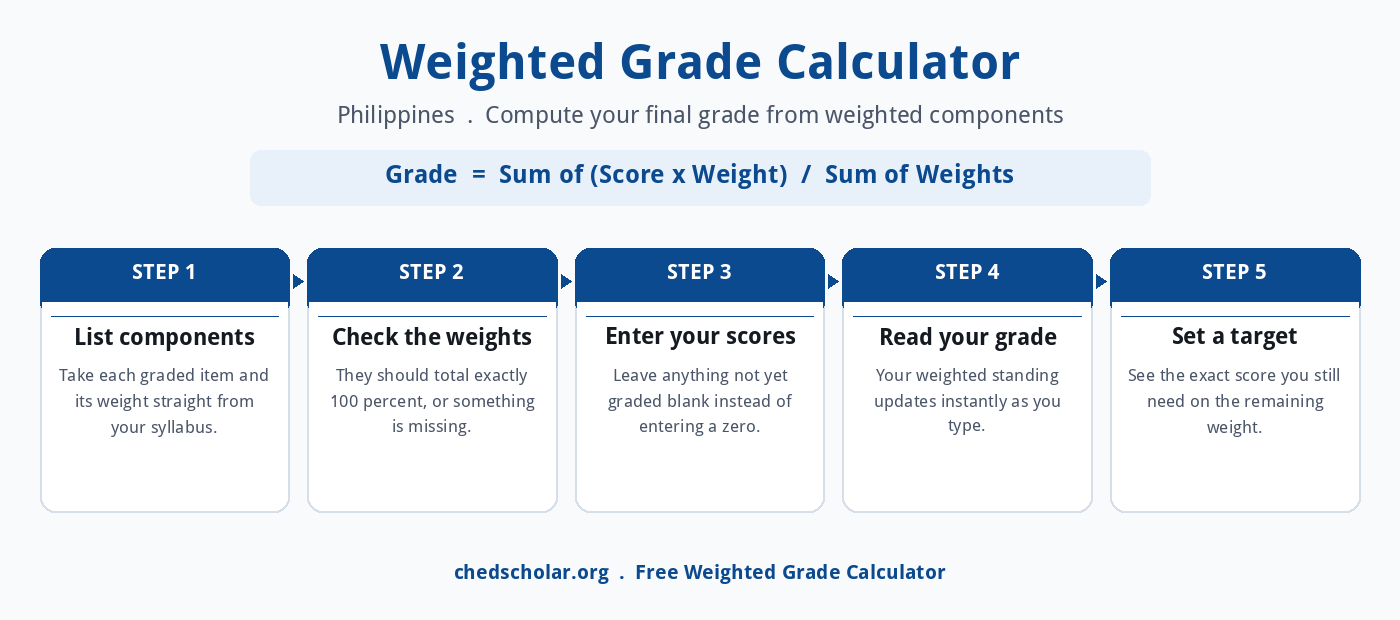
Weighted grade = Sum of (Score × Weight) ÷ Sum of Weights
Multiply each component score by its weight, add all those products together, then divide by the total of the weights. When your weights add up to exactly 100 percent, dividing by 100 gives your final grade directly. The weighted grade calculator above applies this formula every time you type, and it divides by the weight you have actually been graded on so far, which is why a half-finished semester still shows a meaningful standing.
How to Compute Your Final Grade Step by Step
- Open your syllabus and list every graded component with the weight your professor assigned to it.
- Check that the weights total 100 percent. If they do not, you have either missed a component or misread one.
- Write down your score for each component that has already been graded.
- Multiply each score by its weight to get that component’s weighted value.
- Add the weighted values together, then divide by the total weight to get your grade.
Worked Example: Prelim, Midterm and Finals
Many Philippine colleges divide a semester into term exams. Here is a typical 30 / 30 / 40 split:
| Component | Score | Weight | Score × Weight |
|---|---|---|---|
| Prelim | 88 | 30% | 2,640 |
| Midterm | 92 | 30% | 2,760 |
| Finals | 85 | 40% | 3,400 |
Total: (2,640 + 2,760 + 3,400) ÷ 100 = 8,800 ÷ 100 = 88.00. Enter these exact figures into the weighted grade calculator above and it will return 88.00.
Worked Example: Component-Based Grading
Other subjects, especially laboratory and major courses, weight categories of work rather than term exams:
| Component | Score | Weight | Score × Weight |
|---|---|---|---|
| Quizzes | 90 | 20% | 1,800 |
| Laboratory work | 95 | 25% | 2,375 |
| Major exams | 84 | 35% | 2,940 |
| Final project | 93 | 20% | 1,860 |
Total: (1,800 + 2,375 + 2,940 + 1,860) ÷ 100 = 8,975 ÷ 100 = 89.75. Notice that the strongest score (95 in the laboratory) lifts the grade less than the weaker 84 drags it down, because the major exams carry more weight.
Common Grade Weight Systems in Philippine Colleges
There is no single national standard — each school, and often each professor, sets its own. These are patterns you will commonly meet:
| System | Typical split | Where you see it |
|---|---|---|
| Three-term exams | Prelim 30%, Midterm 30%, Finals 40% | Common in many private colleges and universities |
| Four-term exams | Prelim, Midterm, Semi-final, Final at 25% each | Schools running four grading periods |
| Class standing plus exams | Class standing 60%, major exam 40% | Widespread in general education subjects |
| Lecture and laboratory split | Lecture 60% to 70%, laboratory 30% to 40% | Science, engineering and IT courses |
Because the split is set locally, always take your weights from your own syllabus rather than assuming one of these applies to you.
Where to Find Your Component Weights
- Course syllabus: the authoritative source, usually distributed in the first week and stating each component and its percentage.
- Learning management system: many schools publish the grading breakdown alongside the course materials.
- Your professor: if the syllabus is ambiguous, ask directly. The weights determine your grade, so it is a reasonable question.
- Student handbook: some schools set a minimum institution-wide structure that individual subjects must follow.
What Grade Do I Need on the Finals?
This is the question most students actually arrive with, and it is just the weighted grade formula rearranged. If you know your scores so far, the weight still outstanding, and the final grade you are aiming for, the score you need is:
Score needed = (Target × Total weight − Points earned so far) ÷ Remaining weight
Take the earlier example. You scored 88 on the prelim and 92 on the midterm, each worth 30 percent, and the 40 percent final is still ahead of you. You have banked (88 × 30) + (92 × 30) = 5,400 points. To finish with 90 you need (90 × 100 − 5,400) ÷ 40 = 3,600 ÷ 40 = 90 on the final exam. Aiming for 99 instead would require 112.50, which no exam allows — the weighted grade calculator above flags targets like that as out of reach rather than quietly showing an impossible number.
Leave the score blank for any component you have not taken yet, type your target into the box, and the tool works this out for you.
Weighted Grade vs. GWA: Which One Do You Need?
These two calculations sit at different levels and are easy to confuse:
- Weighted grade happens inside one subject. It combines your exams, quizzes and projects, weighted by percentage, into a single final grade for that subject.
- GWA happens across all your subjects. It combines your final grades, weighted by units, into one overall average.
You compute a weighted grade first, once per subject. Then you feed those final grades into a GWA calculator to get the average that scholarships and Latin honors actually look at. If your goal is checking a scholarship cutoff, the GWA is the number you need.
Senior High School: Written Work, Performance Tasks and Quarterly Assessment
DepEd’s K-12 system is a weighted grade system too, just with fixed component names. Every subject grade for a quarter combines three components — Written Work, Performance Tasks and Quarterly Assessment — using weights that differ by subject type. Core subjects, Academic track subjects, and Technical-Vocational or Sports and Arts subjects each use their own percentage split, so a senior high school student cannot apply one set of weights to every subject.
To use the weighted grade calculator above for a DepEd subject, enter the three components with the percentages your teacher or your class record specifies. One thing to keep in mind: DepEd applies an official transmutation table to convert the raw computed score into the final 60 to 100 grade that appears on your report card. This tool gives you the raw weighted score before transmutation, so expect a small difference from the figure your teacher records.
Common Mistakes When Computing a Weighted Grade
- Averaging instead of weighting. Adding your scores and dividing by how many there are ignores the syllabus entirely and will not match your professor’s records.
- Weights that do not total 100. If your components add up to 90 or 110 percent, you have missed or double-counted something. The calculator warns you when this happens.
- Counting ungraded work as a zero. A component you have not taken yet is not a zero — leave it blank, or your standing will look far worse than it is.
- Mixing scales. Do not enter some components as percentages and others on a 1.0 to 5.0 scale. Convert everything to one scale first.
- Rounding each component early. Round only the final result, not every intermediate product, or small errors accumulate.
- Assuming last semester’s weights carry over. A new subject means a new syllabus, and often a different split.
Tips for Protecting Your Grade
- Read the weights in week one. Knowing that the final is worth 40 percent changes how you plan the whole term.
- Compute after every graded component rather than only at the end, so a bad result is something you can still respond to.
- Prioritise by weight, not by deadline. A 35 percent major exam deserves more of your time than a 5 percent seatwork due sooner.
- Use the target box early. Knowing in week ten that you need 78 on the final is far more useful than discovering in week seventeen that you needed 105.
Frequently Asked Questions
How do I compute my final grade with different percentages?
Multiply each component score by its percentage weight, add all the products, then divide by the total of the weights. If your weights total 100, divide by 100. The weighted grade calculator above does this automatically as you type.
What if my component weights do not add up to 100 percent?
Then something is missing or misread — check your syllabus. The calculator still gives a mathematically correct result by dividing by the total weight you entered, and it displays a warning so you know the figure is not a true final grade.
How do I know what score I need on my final exam?
Leave the final exam score blank, enter its weight, type your target grade in the box below the calculator, and the tool computes the exact score required. If the answer is above 100 it tells you the target is unreachable rather than showing an impossible figure.
Is a weighted grade the same as a GWA?
No. A weighted grade is your grade in one subject, weighted by component percentages. A GWA averages your final grades across all subjects, weighted by units. Compute the weighted grade first, then use a GWA calculator for your overall average.
Can I use this for senior high school subjects?
Yes, by entering Written Work, Performance Tasks and Quarterly Assessment with the percentages that apply to that subject type. Remember that DepEd transmutes the raw score afterwards, so your report card figure will differ slightly.
Should I enter a zero for work I have not done yet?
No. Leave the score blank and keep the weight. The calculator then treats that component as still outstanding and includes it in the remaining weight for your target calculation.
Does this work with a 1.0 to 5.0 grading scale?
The arithmetic works with any consistent numeric scale, but the guidance messages assume a percentage scale. Most schools compute component grades as percentages and convert to 1.0 to 5.0 only at the end, so enter percentages here and convert afterwards.
Why is my computed grade different from my professor’s?
The usual causes are a component you did not know about, a different weight than you assumed, dropped lowest scores, bonus or extra credit points, or a school-specific rounding rule. Ask your professor for the breakdown if the gap is significant.
How is class standing computed?
Class standing is itself a weighted grade, usually combining quizzes, recitation, seatwork, attendance and assignments. Compute it as its own weighted grade first, then enter that single figure as one component alongside your major exams.
Can I save or print my computation?
Yes. Use Download as CSV to keep a spreadsheet copy of your components, scores and weights, or Print / Save as PDF for a printable record.
Is my data stored anywhere?
No. Every calculation runs in your own browser using JavaScript. Nothing you enter is transmitted to or stored on any server, which is also why refreshing the page clears your entries.
What is a passing grade in Philippine colleges?
On the common 1.0 to 5.0 scale, 3.00 is typically the passing mark, which corresponds to roughly 75 percent at most schools. Individual subjects can set a higher threshold, so confirm with your syllabus or registrar.
Sources and Further Reading
- Academic grading in the Philippines — reference overview of the numeric, percentage and letter-grade systems used across Philippine schools.
- Department of Education (DepEd) — issues the K-12 component weights and transmutation guidelines used in senior high school.
- Commission on Higher Education (CHED) — sets policy for Philippine higher education and runs national scholarship programs.
This weighted grade calculator is provided as a study aid. Component weights, rounding rules and transmutation tables are set by each school, professor and by DepEd guidelines, and can change — always confirm your official grade with your instructor or registrar.
1 thought on “Weighted Grade Calculator Philippines: Compute Your Final Grade”